
Interstate Move Checklist for New Jersey
How to vet an interstate mover out of New Jersey: the DOT and authority lookup, why a dedicated truck matters, and what a delivery date means.
Interstate moves are where the moving industry has the worst reputation, and most of the horror stories trace back to three things: a mover that isn’t actually licensed for interstate transport, a “shared load” that delays delivery by weeks, and a delivery “window” that turns out to mean a 30-day range. This checklist is how we’d vet a long-distance mover out of New Jersey if we were the customer.
Quick answer
For any interstate move out of NJ, verify the mover’s USDOT number at the FMCSA’s public registry, insist on a dedicated truck (your stuff loaded once, unloaded once, no terminal transfers), and get the delivery date in writing as a specific day rather than a window. Federal law gives you the right to a written binding or not-to-exceed estimate; use it.
1. Verify the USDOT registration
Every interstate household-goods mover in the US is required to be registered with the Federal Motor Carrier Safety Administration (FMCSA) and to display a USDOT number.
How to check it:
- Find the USDOT number on the mover’s website, truck, or contract.
- Go to the FMCSA’s SAFER company snapshot.
- Search by USDOT number and confirm the company name matches, the operating status is “AUTHORIZED FOR HHG” (household goods), and there are no out-of-service orders.
If the mover doesn’t have a USDOT number listed on their website or contract, that’s your answer. Walk away.
NJ also requires intrastate movers to be licensed by the Division of Consumer Affairs, that’s a separate registration. Both should exist for a company doing both in-state and interstate work.
2. Insist on a dedicated truck
This is the single most important question you’ll ask. In the interstate moving industry, the cheap-quote business model is built on consolidation: your stuff is loaded onto a truck that’s also carrying other people’s stuff going in roughly the same direction. The truck stops at a terminal, your stuff is shuffled to a different truck, and eventually it arrives, sometimes within a week, sometimes within a month, sometimes with damage from being handled four extra times.
A dedicated truck means:
- The same truck that loads in NJ is the truck that unloads at your destination
- The same crew (or a single hand-off, written in advance) handles the entire move
- No terminal transfers, no co-loaded freight
- Delivery date is a specific day, not a window
Dedicated trucks cost more than shared loads. That premium is the entire point, you’re paying for predictability and for your stuff not to spend two extra weeks bouncing through terminals.
3. Get the delivery window in writing, as a day, not a range
Federal regulations allow movers to quote a “delivery spread” of 1 to 14 days. Some quote ranges that wide. Some quote “estimated delivery” with no spread at all, which means anything goes.
What to ask for:
- A specific delivery date written in the contract
- If a range is unavoidable (rare for a dedicated truck), no more than 2 to 3 days
- A penalty clause for the mover if delivery slips beyond the agreed window, or storage included free
Reputable interstate movers will give you a specific date in writing because they’re operating a dedicated truck and they know when it will arrive.
4. Confirm the binding-quote type
Federal law recognizes three estimate types for interstate moves:
Binding estimate. The price is fixed for the inventory listed. If the inventory grows on move day, the price can change, but only by mutual agreement before loading.
Non-binding estimate. This is an estimate. The final price is based on actual weight or volume at the warehouse. The mover can’t charge more than 110% of the estimate at delivery (you have 30 days to pay the rest), but the final number is determined after the fact.
Not-to-exceed estimate. A hybrid, the price is whatever the actual weight comes out to, but it cannot exceed the quoted figure.
For most customers, binding is the right choice. You know the number, the mover takes on the inventory-counting risk.
5. Confirm insurance and valuation
Federal regulations require interstate movers to offer two levels of liability:
Released value protection. Free, but covers only 60 cents per pound per item. A 50-pound TV worth $1,500 is covered for $30. This is essentially no coverage.
Full value protection. A separately priced policy, typically a small percentage of the declared value of your shipment. The mover is liable for the actual replacement cost of damaged or lost items.
For any move with electronics, art, or anything worth more than a few hundred dollars, take full-value protection. The premium is usually 1 to 2% of the declared value and is worth every dollar.
6. Read the bill of lading before the truck leaves
The bill of lading is the contract. By the time the loaded truck pulls away, you should have:
- A copy of the bill of lading signed by you and the foreman
- A signed inventory list, with condition notes on every piece
- A copy of the binding estimate (or not-to-exceed estimate) referenced in the bill of lading
- Contact information for the dispatcher and the dedicated foreman on your move
If anything material changes between the quote and the load day, get it in writing before the truck leaves.
7. Plan the destination logistics
A common surprise on long-distance moves is the destination-end work. Get this in writing:
- Confirm whether the price includes carry-in to a specific floor (and not just curbside delivery)
- Confirm the time window for the destination end, most reputable movers give a delivery-day window of a few hours
- Confirm what happens if you can’t accept delivery on the agreed day (storage at the destination warehouse, free for X days)
A condensed checklist
- USDOT number verified on FMCSA SAFER, status “AUTHORIZED FOR HHG”
- NJ Division of Consumer Affairs license (for in-state portion)
- Dedicated truck, no terminal transfers, no shared load
- Specific delivery date in writing (not a window of more than 2 to 3 days)
- Binding or not-to-exceed estimate type
- Full-value insurance protection elected if shipment is valuable
- Inventory list signed at load with condition notes
- Bill of lading reviewed and signed before truck departs
- Destination logistics confirmed (carry-in, time window, storage fallback)
How we handle interstate
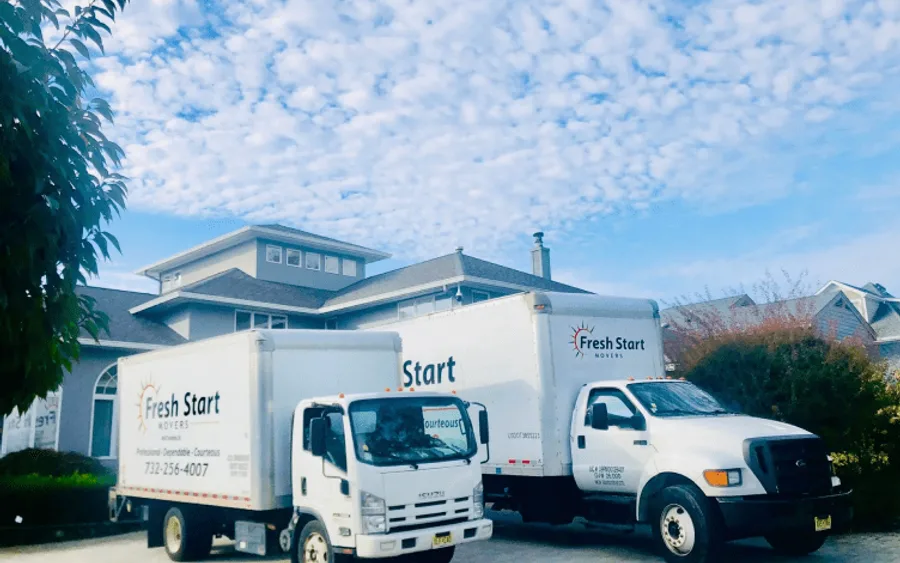
Fresh Start Movers is USDOT licensed for interstate household goods. Every long-distance move uses a dedicated truck, the same vehicle and the same crew from NJ to wherever you’re going. Delivery is a specific date in writing, with GPS check-ins during transit.
Most-requested routes out of our central-NJ coverage area are NJ-to-Florida and NJ-to-Carolinas. Before move day, how to read a moving quote is worth reading. On an interstate move federal rules require a written estimate, so hourly billing is not something to accept.
More from the truck.

Downsizing Into an Ocean County Adult Community
Downsizing into an Ocean County adult community is two jobs at once. What the communities require, and the order that makes it bearable.
Read Choosing a Mover in Central NJ: What Is Different Here
What makes a central New Jersey move different: shore traffic, barrier island access, pre war staircases, and the two licenses to check.
Read